How to Write Children's Picture Books with AI Illustrations
Learn how to write and illustrate a children's picture book using AI tools — from crafting your story to producing print-ready pages you own outright.
Creating a children’s picture book used to require either a significant budget to hire an illustrator or years of practice to develop your own artistic skills. AI changes that equation completely: today a writer, educator, or first-time author can move from story idea to a fully illustrated, print-ready book in a single focused session.
Why Children’s Picture Books Are a Smart First Project
Picture books sit at a unique crossroads of brevity and impact. A typical 32-page picture book contains only 500 to 1,000 words of text, which means the craft challenge is not length — it is precision. Every sentence has to earn its place. Every spread has to carry visual weight. That tight constraint makes picture books an ideal format for writers who want a finished product quickly, and it makes them well-suited to AI-assisted production where clear, specific prompts produce the best results.
There is also a durable commercial market. Self-published children’s books sell consistently on Amazon KDP, Etsy (as printable PDFs), and through school book fairs. Parents, grandparents, teachers, and therapists are all steady buyers. If you own the rights to your text and illustrations — which you do when you create them through Artistik — you can sell, license, or gift your book without restriction.
Start with a Story Architecture, Not a Story
Before you write a single line of text, map out the architecture. Picture books follow a dependable structure:
- A child-centered protagonist who wants something or faces a specific problem
- Three escalating obstacles that feel real to a young reader
- A resolution the child reaches through their own action or insight
- An emotional takeaway that resonates without being preachy
Write this out in four bullet points before you draft anything. Knowing your ending before your opening prevents the most common picture book failure: a meandering middle that loses young readers and adult read-aloud partners alike.
Also decide your age target upfront. Books for ages 2-4 rely almost entirely on illustration; text is single words or very short sentences. Ages 4-6 can handle one or two sentences per spread. Ages 6-8 (the early reader picture book) can carry a short paragraph per page. Your age target dictates sentence length, vocabulary, and how much narrative weight the illustrations must carry.
Writing Text That Works with Illustrations
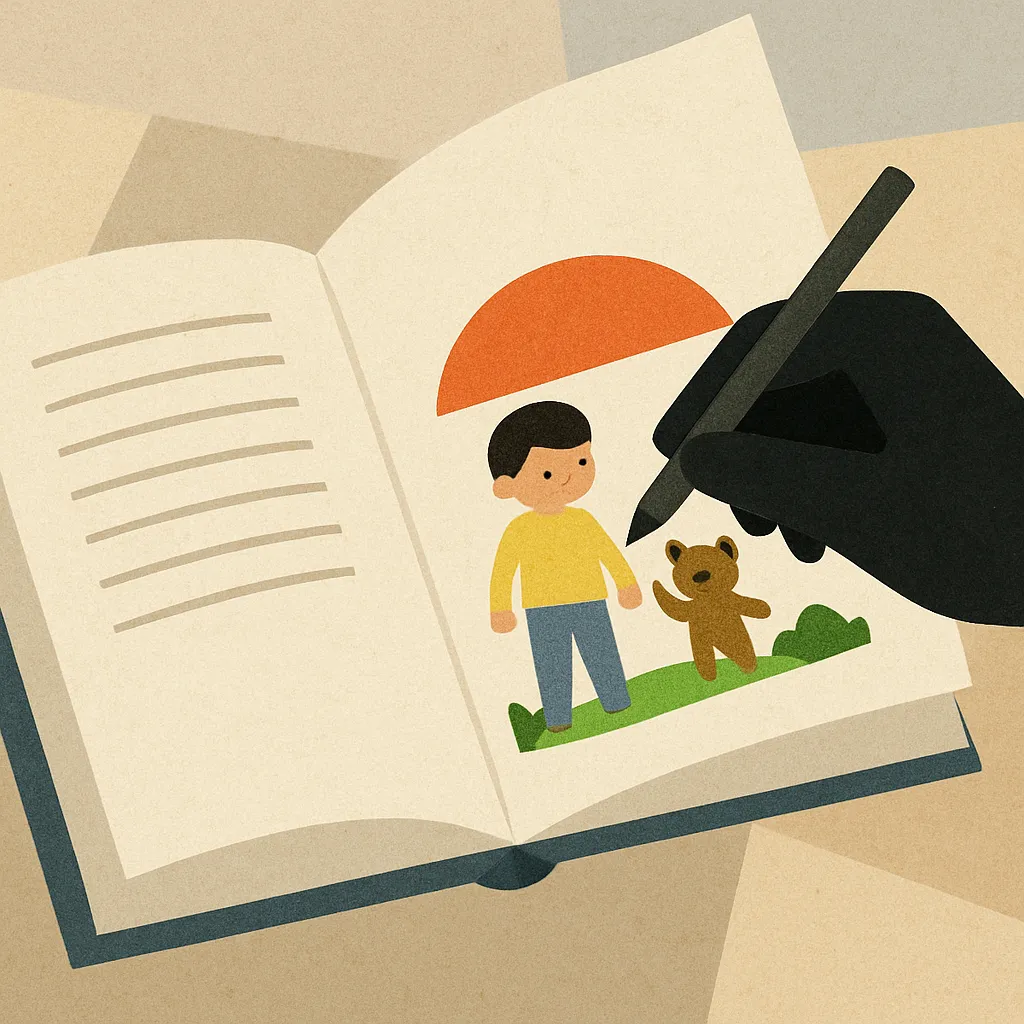
The cardinal rule of picture book writing is that your text and illustrations must not repeat each other — they must extend each other. If your text says “Maya was scared,” your illustration should show us why and how, not simply depict a scared face. Conversely, if the illustration shows a room full of birthday balloons, your text does not need to mention the balloons.
Practical techniques for picture-book-specific prose:
- Write in present tense. It creates immediacy and suits read-aloud rhythm.
- Read every sentence aloud. Children’s books are performed. Awkward phrasing is immediately obvious when spoken.
- Cut adverbs ruthlessly. “She ran” paired with a dynamic illustration outperforms “She ran quickly” every time.
- End page spreads on a question or tension. This is what makes children say “keep reading.”
- Use sound words sparingly but deliberately. Onomatopoeia (crash, whoosh, plop) gives read-alouds texture.
A useful formatting exercise: draft your text as a simple two-column table — left column for the words on each spread, right column for a one-sentence illustration note describing what the picture should show. This discipline forces you to think visually and produces much better AI image prompts later.
Drafting Your Spread-by-Spread Illustration Prompts
This is where most first-time AI picture book creators slow down, and it is worth slowing down here. A vague prompt produces a generic illustration. A specific prompt produces a consistent, emotionally resonant one.
For each spread, your illustration prompt should include:
| Element | Example |
|---|---|
| Art style | “Watercolor, soft edges, warm palette, similar to classic picture book illustration” |
| Character description | “A girl, age 6, brown curly hair, wearing red overalls” |
| Setting | “A backyard garden at golden hour, tall sunflowers in the background” |
| Action or emotion | “Kneeling in the dirt, looking surprised and delighted” |
| Perspective | “Eye-level, wide shot showing full figure” |
Consistency across spreads is critical. Establish your character’s physical description and art style in a reference note you copy into every prompt. Small deviations — a character’s hair color shifting, a style moving from painterly to graphic — will break the cohesion of the final book.
Building the Book with AI Tools
Once your text and illustration prompts are ready, Artistik can accelerate the production step substantially. The platform lets you feed in your story and creative direction and outputs a structured, downloadable file you actually own. For picture books, the coloring book format is also worth exploring — start a coloring book from your existing story and you have a companion activity product with almost no additional writing work.
For authors who want to extend their picture book into an audio experience — increasingly popular for children’s apps and Audible’s kids catalog — the same source material can be adapted into an audiobook with narration pacing notes built in.
Downloaded files are royalty-free. You can upload directly to KDP, format for Etsy digital download, or send to a local print shop for a physical proof.
Formatting for Print: What to Know Before You Export
KDP and most print-on-demand services require specific trim sizes and bleed settings for picture books. The most common trim size for a standard picture book is 8.5 x 8.5 inches or 8 x 10 inches. Key specifications to verify before uploading:
- Bleed: 0.125 inches on all sides (images must extend beyond the trim line)
- Resolution: 300 DPI minimum for all illustration assets
- Color mode: CMYK for print; RGB for digital-only distribution
- Safe zone: Keep all critical text at least 0.25 inches inside the trim line
If you are producing a digital-only PDF for Etsy, resolution still matters — parents printing at home will notice muddy artwork.
Frequently Asked Questions
Do I need any drawing ability to make an AI-illustrated picture book? No. You need the ability to describe scenes clearly in writing. The more specific and visual your language, the better your AI-generated illustrations will be. Think of yourself as an art director giving briefs, not an artist holding a brush.
How do I keep my characters looking the same across every page? Consistency comes from your prompts. Build a character description template — hair, skin tone, clothing, approximate age, art style — and paste it into every illustration prompt verbatim. Review all images side by side before assembling the final layout and regenerate any that drift noticeably.
Can I sell an AI-illustrated children’s book on Amazon KDP? Yes. Amazon KDP does not prohibit AI-assisted illustrations, and files created through Artistik are yours to sell, distribute, or license. Always review KDP’s current content policies before publishing, as platform rules can be updated.
What is the realistic timeline from idea to finished book? A focused writer can produce a complete, illustrated 32-page picture book in one to three days. The story draft and spread-by-spread planning take the longest. Generation and layout assembly, with a clear prompt set ready, can be completed in a single afternoon.
Ready to Write Your First Picture Book?
Children’s picture books reward specificity, rhythm, and visual thinking — all skills you can develop and apply today, without an illustration budget or a publishing contract. If you have a story idea sitting in a notebook or a character living rent-free in your head, now is the right moment to build it into something real. Visit Artistik and start turning your concept into a finished, royalty-free book you can share with the world.