Micro Drama Script Structure, Beat by Beat
Learn the hook, escalation and cliffhanger pattern that makes vertical micro dramas addictive, with a full worked example you can copy today.
A good micro drama lives or dies in its first three seconds and its last three seconds. Get the hook and the cliffhanger right, keep the middle moving, and viewers will tap “next” without thinking. This guide breaks down the structure beat by beat, then builds a full nine-shot script you can copy and adapt.

Micro dramas are vertical, under three minutes, and built for a thumb that is ready to scroll. The writing is different from a normal short film because you have almost no runway. Every shot has to earn the next one. The pattern that works, over and over, is simple to name and harder to execute: hook, escalation, cliffhanger. Let’s take it apart.
Why micro drama structure is its own craft
A micro drama is not a trailer and not a TikTok skit. It is a single episode of a serialized story, usually six to twelve shots, designed so that the moment it ends you need the next one. The whole thing is vertical 9:16, built for full-screen phone viewing, and it almost always carries burned-in captions because a lot of people watch with the sound off at first.
That changes how you write. In a feature you can let a scene breathe. Here, a scene that breathes is a scene that loses the viewer. The structure has to do three jobs in rapid succession:
- Stop the scroll (the hook).
- Raise the stakes fast enough that the viewer stays invested (escalation).
- End on a question the viewer cannot leave unanswered (the cliffhanger).
Genres like romance, revenge, billionaire, secret identity and thriller work so well in this format precisely because they are built on strong, legible emotions and clear power shifts. You don’t have time for subtle character study. You have time for a slap, a secret, a reveal, a choice.
If you want to see the format and its options first, the Micro Drama page lays out the lengths, looks and modes. But the structure below applies no matter which tools you use to produce it.
The three-act skeleton, compressed
Think of the classic three-act shape squeezed into under three minutes. The proportions roughly hold:
Act one: the hook (about the first 20 percent)
Your opening shot has one job: make scrolling feel like a mistake. You do that by dropping the viewer into the middle of a charged moment, not the beginning of a calm one. Start late, start hot. A confrontation already underway. A secret about to be said. A character caught doing something they shouldn’t.
The hook is not exposition. It is tension with a question attached. “Who is she?” “What did he just find?” “Why is she crying in a wedding dress?” You answer just enough to keep them, and withhold the rest.
Act two: the escalation (about the middle 60 percent)
Now you raise the stakes in steps. Each beat should make the situation worse, more personal, or more surprising than the last. The mistake new writers make is to hold the tension flat. Flat is death. You want a staircase, not a hallway.
Escalation works through reversals. The viewer thinks they understand the situation, then you flip it. He’s the waiter — no, he owns the building. She’s the assistant — no, she’s the daughter he abandoned. Every reversal is a small payoff that buys you the viewer’s attention for the next beat.
Act three: the cliffhanger (the last 20 percent)
End on the sharpest unanswered question you have. The best cliffhangers are not random shocks; they are the natural next beat of the escalation, cut off one second before the viewer gets relief. A door opens and we see who’s behind it — cut. A phone buzzes with a name we recognize — cut. A character says “There’s something I never told you” — cut.
The goal is a specific feeling: I have to know what happens next. If your ending produces “huh, okay,” rewrite it.
The beats, shot by shot
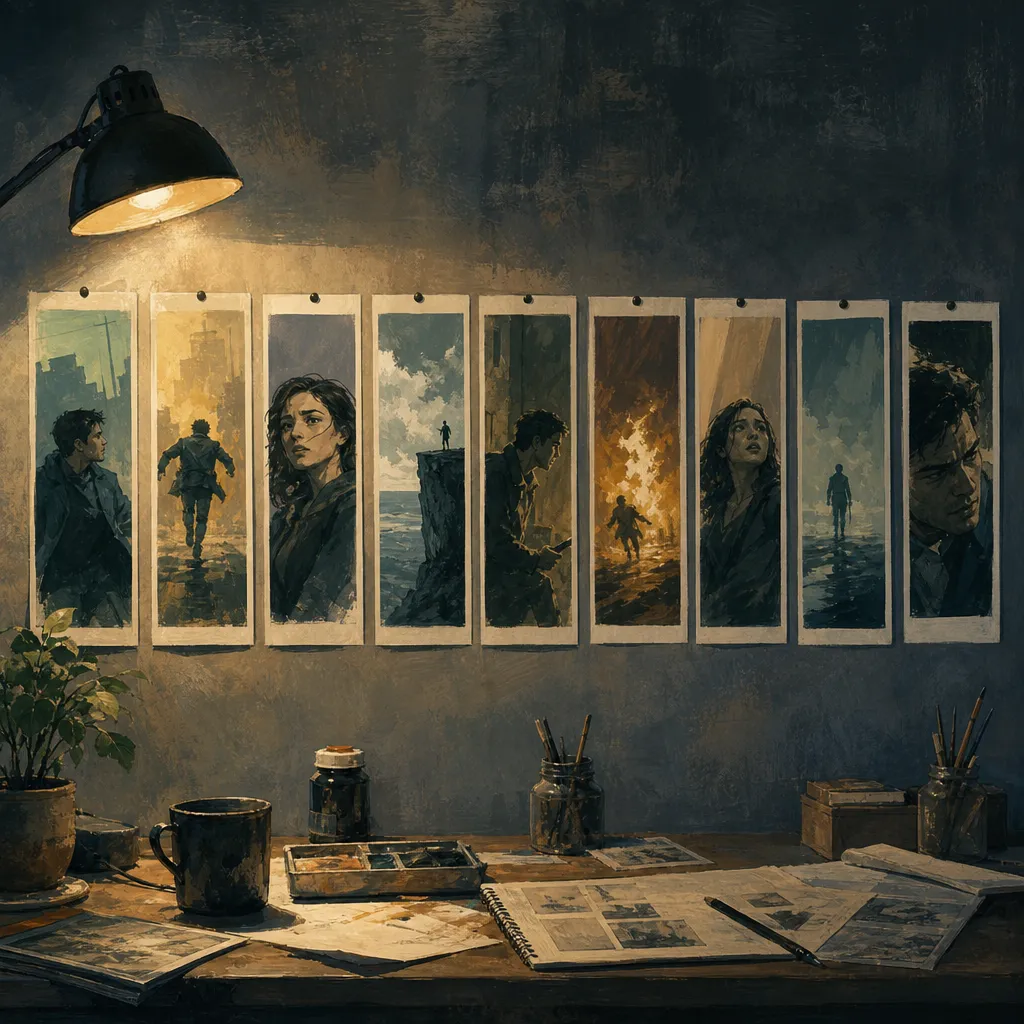
Let’s map a standard nine-shot episode. This is a reliable template you can reuse across an entire season. Shot counts vary — a quick episode runs about six shots, standard about nine, binge about twelve — but the job of each position is the same.
- Cold open (hook). Drop into conflict. A line of dialogue or an action that raises a question. No setup.
- Context flash. One shot that tells us just enough: who these people are and what’s at stake. Keep it to a single clear fact.
- First complication. The situation gets harder. A new obstacle or a demand.
- First reversal. Flip an assumption. The viewer learns something that recolors shots one through three.
- Raise the personal stakes. Make it hurt. Tie the conflict to something the character — and the viewer — cares about.
- Second complication. A ticking clock, a threat, a deadline, a witness.
- Second reversal. The bigger twist. The real power dynamic shows itself.
- The brink. Push the characters to a decision or a confrontation. Maximum pressure.
- Cliffhanger. Cut one beat before resolution on the strongest open question.
Notice how shots four and seven carry the reversals. Those are your load-bearing beats. If an episode feels flat, it almost always lacks a real reversal in one of those two spots.
A worked example: a revenge micro drama
Let’s build a standard, nine-shot revenge episode called The Returned Heir. I’ll write it as the one-sentence idea you’d actually paste into a tool, then show the beat map that comes out of it.
Here’s the prompt you could use:
A revenge micro drama, cinematic look, 9 shots: a young woman returns to the luxury company that fired her mother years ago, hired as a lowly temp — but she secretly owns a controlling stake and plans to take it apart from the inside. End on a cliffhanger. 13 languages optional; burn in karaoke captions.
And here’s how the beats land:
- Shot 1 (hook). A sleek lobby. A sharp-suited executive snaps, “You’re the new temp? Don’t touch anything expensive.” Close on the woman’s calm half-smile. Question: why is she smiling?
- Shot 2 (context). She rides the elevator up alone, passing a portrait of the late founder. We catch her whisper: “Hi, Dad.” One fact: she belongs here more than they know.
- Shot 3 (first complication). The executive dumps a week of work on her desk, due by morning, meant to break her.
- Shot 4 (first reversal). Night. She opens a laptop and we see a board document: majority shareholder, her name. Everything reframes.
- Shot 5 (personal stakes). A framed photo in her bag: her mother, in the same lobby, years ago, being escorted out crying.
- Shot 6 (second complication). The executive schedules an emergency board meeting to “clean house” — and her temp position is first on the list.
- Shot 7 (second reversal). In the meeting, the chairman asks, “Before we vote — who actually controls this company now?” He looks straight at her.
- Shot 8 (the brink). She stands. The room goes silent. The executive laughs, then stops.
- Shot 9 (cliffhanger). She slides a folder across the table and says, “Let’s start with what you did to my mother.” Hard cut to black. End episode one.
Every beat is worse or bigger than the one before it, the reversals sit on shots four and seven, and the episode ends one line before relief. That’s the whole trick.
Writing dialogue that fits the format
Keep lines short and declarative. Vertical viewers read captions as much as they listen, and long speeches scroll past. One strong line beats three medium ones. Subtext is good, but make sure the surface action is always clear — the viewer should never be confused about who wants what.
How the production side works
A script is only half of a micro drama; the other half is turning those beats into a vertical video with captions, voices and a consistent cast. You can storyboard this by hand, but tools can do the heavy lifting.
In Artistik, you start from one sentence like the prompt above and get a finished 1080x1920 MP4 plus the script. You choose a length (quick, standard or binge), a genre, and a look — cinematic, anime, webtoon, 3D, noir or painterly. The output carries a consistent cast across shots, voices, and word-by-word karaoke captions burned in, with optional music and sound effects. Script, voices and captions are available in 13 languages.
There are three ways to produce the visuals:
- Narrated storyboard — stills with a slow push-in. This mode works with the free starter credit, so you can test a full structure without buying anything.
- Motion — animated clips, which use purchased credit.
- Hybrid — motion plus lip-synced talking scenes, also on purchased credit.
For writing and testing structure, the narrated storyboard mode is your friend: you can draft a whole episode, watch the beats land, rewrite the hook or cliffhanger, and only move to motion once the structure holds.
If you want a serialized show rather than a one-off, you can plan a whole season with a persistent cast, which is exactly how the worked example above is designed — The Returned Heir is episode one of many.
What this format can and can’t do
Be honest with yourself about the limits before you start.
A micro drama is under three minutes. It is not a place for slow character arcs or big ensemble casts with many threads. One or two leads and one clear conflict per episode. Save the subplots for later episodes.
The generated cast is consistent across shots within a plan, which is what makes serialization possible, but it is a generated cast, not real actors you direct take by take. You steer it with the script and the brief, not with on-set notes.
And the structure only works if you commit to it. A cliffhanger that resolves everything is not a cliffhanger. The discipline is to always leave one question open.
Micro drama cost compared with related formats
Here’s roughly what one finished piece costs across a few formats, so you can plan a project.
| Format | Typical cost per finished piece |
|---|---|
| Micro Drama | about $0.10–$6 |
| Short-form video | about $0.15–$1 |
| Webtoon | about $0.35–$0.60 |
| Screenplay | about $0.15–$1 |
The range for micro drama is wide because narrated storyboard is far cheaper than full motion or hybrid, which run on purchased credit. On pricing: your first piece is on us with up to $1 of free starter credit, you can keep any single piece for a one-off $4.99, add credit from $5, or go with a monthly plan from $9 that includes that dollar amount of making and removes watermarks — see pricing for the details.
Quick tools to plan before you write
Before you commit to a shot count, it helps to sanity-check pacing. If you’re scripting voiceover or narration, the video script length tool converts words to seconds so you don’t overwrite a shot. It’s free and needs no signup — useful for making sure your hook lands inside the first few seconds instead of sprawling.
Frequently asked questions
How many shots should a micro drama episode have? A standard episode runs about nine shots, with quick episodes around six and binge episodes around twelve. More shots give you more room for reversals, but the three-act proportions stay the same regardless.
Where should the first reversal go? Place it at roughly the one-third mark — in a nine-shot episode, that’s shot four. A second, bigger reversal around shot seven keeps the escalation climbing toward the cliffhanger.
Can I test a script without paying? Yes. The narrated storyboard mode works with the free starter credit, which covers one first piece, so you can draft and watch a full episode before deciding whether to move to motion or keep it. Motion and hybrid modes use purchased credit.
Can I make a whole series with the same characters? Yes. A whole season can be planned with a persistent cast, so the same leads carry across episodes. Design episode one to end on a cliffhanger that opens the door to episode two.
What’s the difference between a cliffhanger and just stopping? A cliffhanger cuts off the natural next beat of the escalation one second before relief, leaving a specific unanswered question. Just stopping leaves the viewer with “okay” instead of “I have to know what happens next.”
The fastest way to learn this structure is to write one episode, watch it play, and feel where the energy sags. Start with the free starter credit, paste a one-sentence idea, and build your first hook-escalation-cliffhanger episode on the Micro Drama page — then keep the one that makes you want to tap “next.”