AI Graphic Novel Dialogue: Write Punchy, Character-Driven Script
Learn how to craft sharp, character-specific dialogue for AI-generated graphic novels — from voice differentiation to pacing across panels.
AI Graphic Novel Dialogue: Write Punchy, Character-Driven Script
Dialogue is where AI-generated graphic novels either click or collapse. Get it right and your characters feel lived-in; get it wrong and every panel reads like a instruction manual. This guide gives you a practical, step-by-step method for writing dialogue that is specific to each character, paced for the visual medium, and ready to feed into an AI creative tool like Artistik.

Why Graphic Novel Dialogue Is Its Own Craft
Novels can lean on narration. Films use an actor’s face, pause, and tone. Graphic novels do neither — they hand dialogue to a static image inside a balloon with perhaps thirty words of space. Every line must do triple duty: reveal character, advance plot, and cue the artist (or AI) on what emotion the panel should carry.
When you work with an AI platform to start a graphic novel, your prompt is essentially your script. Vague dialogue instructions produce generic speech. Precise ones produce panels that feel authored.
The stakes are higher than most writers expect.
Build a Voice Card Before You Write a Single Line
Before drafting dialogue, write a one-paragraph voice card for each speaking character. This is not backstory — it is a description of how the character talks. Include:
- Vocabulary range: Do they use technical jargon, slang, formal diction, or a regional dialect?
- Sentence length habit: Short staccato bursts, or long run-on sentences that tumble over themselves?
- Verbal tic or signature phrase: A word they overuse, a habit of answering questions with questions, a tendency to trail off.
- What they never say: Equally important. A career soldier might never say “I feel.” A teenager might never use passive voice.
Example voice card for a cynical ex-journalist character: Speaks in clipped declaratives. Favors nouns over adjectives. Uses irony as a defense mechanism. Never asks for help directly — instead makes observations that imply a request. Avoids the word “sorry.”
Once you have this card, every line you draft can be tested against it. Does this line sound like her, or does it sound like you?
The 30-Word Rule and How to Use It
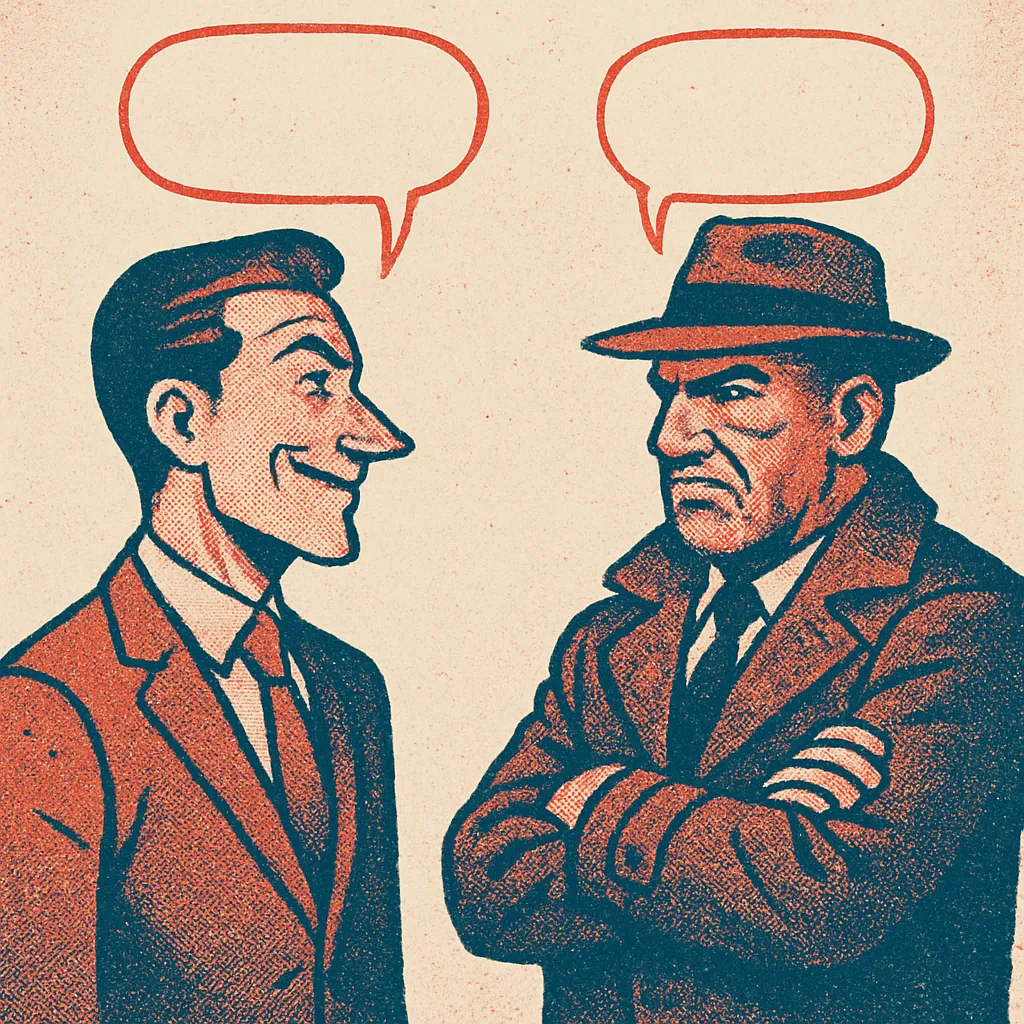
A standard speech balloon in a graphic novel holds roughly 20 to 35 words before it begins to crowd the art. That is not a limitation — it is a discipline that improves your writing.
Here is how to apply it practically:
- Write the line at full length first. Do not self-censor. Let the character say what they need to say.
- Cut to the bone. Remove every word that does not change meaning or voice. “I really don’t think that’s something I want to do” becomes “No. Not a chance.”
- Check if silence works better. Some of the most powerful panels in graphic novel history are wordless. If an image can carry the emotional beat, delete the line entirely and note “silent panel” in your scene description.
- Split across panels if necessary. A long thought can be broken into two or three balloons across sequential panels, creating rhythm and a sense of the character working through something in real time.
When you write your scene prompt in Artistik, structure your dialogue with panel-by-panel breakdown so the AI understands which line belongs to which visual beat.
Differentiate Characters Through Conflict, Not Description
A common mistake is describing how characters are different rather than showing it through disagreement. Put two characters with opposing speech patterns into a scene where they want different things, and differentiation becomes automatic.
Consider this principle in practice:
| Character | Want in Scene | Speech Pattern | How Conflict Reveals Voice |
|---|---|---|---|
| Mara (tactician) | Wants the group to wait | Precise, conditional language | “If we move before midnight, we lose the advantage. Full stop.” |
| Dex (hothead) | Wants to act now | Fragments, imperatives | “Waiting is losing. We go. Now.” |
| Yuki (mediator) | Wants both to calm down | Questions, inclusive pronouns | “What does ‘advantage’ get us if we’re too tired to use it?” |
You do not need to label who is speaking if the voice is distinct enough. In a well-crafted graphic novel script, a reader who covers the character art should still know who said what.
Pacing Dialogue Across a Page Turn
Page turns are the graphic novel’s version of a chapter break — the reader’s eye leaves one spread and lands on the next. This is your most powerful dramatic tool, and dialogue can control it.
- End a page on a question or a revelation. This compels the reader to turn.
- Open the next page mid-reaction. Do not answer the question in the first balloon. Let the art of the opening panel carry the emotional response before the character speaks.
- Use a one-word panel. A single balloon with “No.” or “When?” or a character’s name being called is often more arresting than a paragraph of explanation.
When structuring your scene description for an AI graphic novel tool, explicitly note page breaks in your prompt. Something like: [Page break here — next page opens on Marcus’s face before he responds.] gives the system — or any collaborator — the context it needs.
Writing Action Lines That Inform the Art
In a screenplay you write action lines for a director. In a graphic novel script, you write panel descriptions for an artist or, in the AI workflow, for the image-generation model. These descriptions must be tightly linked to your dialogue because the art and the words must tell the same story from two angles simultaneously.
Bad panel description: Two people talk in a room.
Better panel description: Tight two-shot. Mara is turned slightly away, arms crossed, eyes on the window. Dex is leaning forward into her space, one hand flat on the table. Neither is looking at the other.
The second version tells the reader everything about the power dynamic without a single word of dialogue.
Frequently Asked Questions
How much dialogue is too much for a single graphic novel page? A general guideline is no more than 100 to 120 words of dialogue per page across all balloons combined. Beyond that, the art gets buried and the reading experience slows. If you have more to say, split the scene across additional pages or convert some dialogue into caption boxes.
Can I write graphic novel scripts with no prior comic experience? Absolutely. The fundamentals — character voice, scene objective, visual economy — are skills any fiction writer already has. The panel-by-panel format is easy to learn, and tools like Artistik handle the visual output, so you can focus on the writing.
Should I write full script (panel-by-panel) or a plot-first Marvel-style outline? For AI-assisted graphic novel creation, full script works better. Plot-first outlines give an artist interpretive freedom that a human can use but an AI system needs specified. The more granular your panel descriptions and dialogue placement, the more controlled your final output will be.
How do I handle dialect or accent without being offensive or unreadable? Use light suggestion rather than phonetic spelling. One or two characteristic words or grammatical constructions are enough to signal a regional or cultural speech pattern. Full phonetic transcription is hard to read and can tip into caricature. Trust the voice card to do the heavy lifting.
Start Writing Characters Who Sound Like Themselves
Strong dialogue is not about being clever — it is about being specific. Know who your character is before they open their mouth, respect the visual constraints of the medium, and use conflict to let those voices distinguish themselves naturally. With that foundation in place, your AI-generated panels will carry real dramatic weight.
Ready to put it into practice? Head to Artistik and start your graphic novel today. Paste in your first scene, your voice cards, and your panel descriptions — and watch your characters come to life on the page.