AI Graphic Novel Dialogue: Write Believable Character Voices
Flat dialogue kills graphic novels. Learn how to prompt AI for distinct, authentic character voices that carry emotion, subtext, and pacing across every panel.
Dialogue is the engine of any graphic novel — it reveals character, advances plot, and does the heavy lifting that images alone cannot. If every character in your story sounds like the same person wearing a different costume, readers will check out by page three. Here is a concrete, step-by-step method for prompting AI to generate genuinely distinct character voices, and then refining them into something worth reading.

Why Character Voice Is Harder in Comics Than in Prose
In a novel, you have paragraphs of interiority to differentiate people. In a graphic novel, a character might speak four words per panel. Those four words have to carry personality, emotional state, educational background, and relationship dynamic all at once — because the image handles the visual context. That compression is what makes comics dialogue its own discipline, and it is also what makes AI prompting for this format genuinely tricky.
Most default AI outputs land in what writers call the “neutral narrator” voice: grammatically clean, emotionally moderate, and indistinguishable from panel to panel. Getting past that requires deliberate prompting strategy, not just asking for “better dialogue.”
Build a Voice Sheet Before You Write a Single Line

Before generating any actual script pages, create a one-page voice sheet for each major character and feed it to the AI as system context. A voice sheet does not need to be long — it needs to be specific. Include:
- Vocabulary ceiling: Does this person use polysyllabic words casually, or do they reach for the simplest word available?
- Sentence rhythm: Short declarative punches, or winding clauses with qualifications?
- What they never say: A street-hardened detective probably never says “I appreciate your perspective.” Defining negatives is as useful as defining positives.
- Their verbal tic or tell: A filler phrase, a habit of asking rhetorical questions, a tendency to redirect to themselves.
- Emotional default: Are they guarded, performatively upbeat, blunt, evasive?
Here is an example contrast between two characters:
| Trait | Mara (the engineer) | Dex (the con artist) |
|---|---|---|
| Vocabulary | Technical, precise, no slang | Slang-heavy, adapts to whoever he’s talking to |
| Sentence length | Medium; explains things in steps | Short bursts; leaves sentences unfinished |
| Never says | Approximations (“kind of,” “sort of”) | Anything that pins him down to a fact |
| Verbal tic | Cites numbers even when unnecessary | Answers questions with questions |
| Emotional default | Pragmatic, slightly cold | Warm on the surface, calculating underneath |
Once this sheet exists, paste it verbatim into your prompt as character context. The AI now has constraints to work inside rather than an empty field to fill.
Prompting for Scene-Level Dialogue: The Three-Pass Method
Do not ask for finished dialogue in one shot. Use three passes:
Pass one — functional draft. Ask the AI to write the scene with the sole goal of getting information across. Tell it to ignore style entirely. This gives you a skeleton of what the scene needs to accomplish.
Pass two — voice translation. Feed the functional draft back with the voice sheets and ask the AI to rewrite each character’s lines in their specific voice without changing what is communicated. You will often catch places where the information itself does not survive the translation — that is useful feedback. It means the scene was relying on neutral exposition rather than character.
Pass three — compression. Comics dialogue lives or dies on brevity. Ask the AI to cut every line by thirty percent without losing meaning or voice. This pass almost always produces the best version, because it forces specificity.
Using Artistik to start a graphic novel, you can feed the revised script directly into the generation pipeline, which means each pass feeds naturally into the finished illustrated output rather than sitting in a separate document.
Subtext: Teaching AI to Say One Thing and Mean Another
The most memorable comics dialogue is not about what characters say; it is about what they do not say. Subtext — the emotional content running beneath the literal words — is something AI tends to flatten unless you explicitly prompt for it.
Try this prompt structure: “Character A wants X but cannot ask for it directly because of Y. Write the exchange so that A’s real need is visible to the reader but not stated by any character.”
That instruction forces the model to hold two registers simultaneously. You will still need to edit, but the raw output will be dramatically closer to layered dialogue than a straightforward “write a scene where A and B argue” prompt.
Specific scenarios where subtext prompting matters most: - Reunion scenes between characters with unresolved history - Arguments that are actually about something else entirely - Moments where a character is lying but the reader should suspect it - Any scene where power is shifting between two people
Pacing Dialogue Across Panels
One thing prose writers adapting to graphic novels consistently underestimate is that panel count is dialogue pacing. A single exchange that takes three panels reads slower and more dramatically than the same words crammed into one panel. When you generate dialogue, also specify intended panel count for the scene and ask the AI to distribute the exchange accordingly.
For example: “This is a five-panel sequence. The first two panels are silent action. Panels three and four carry the argument. Panel five is one line each.” That structural context shapes output in ways that generic scene prompts simply cannot.
Reading Dialogue Aloud: The Non-Negotiable Edit
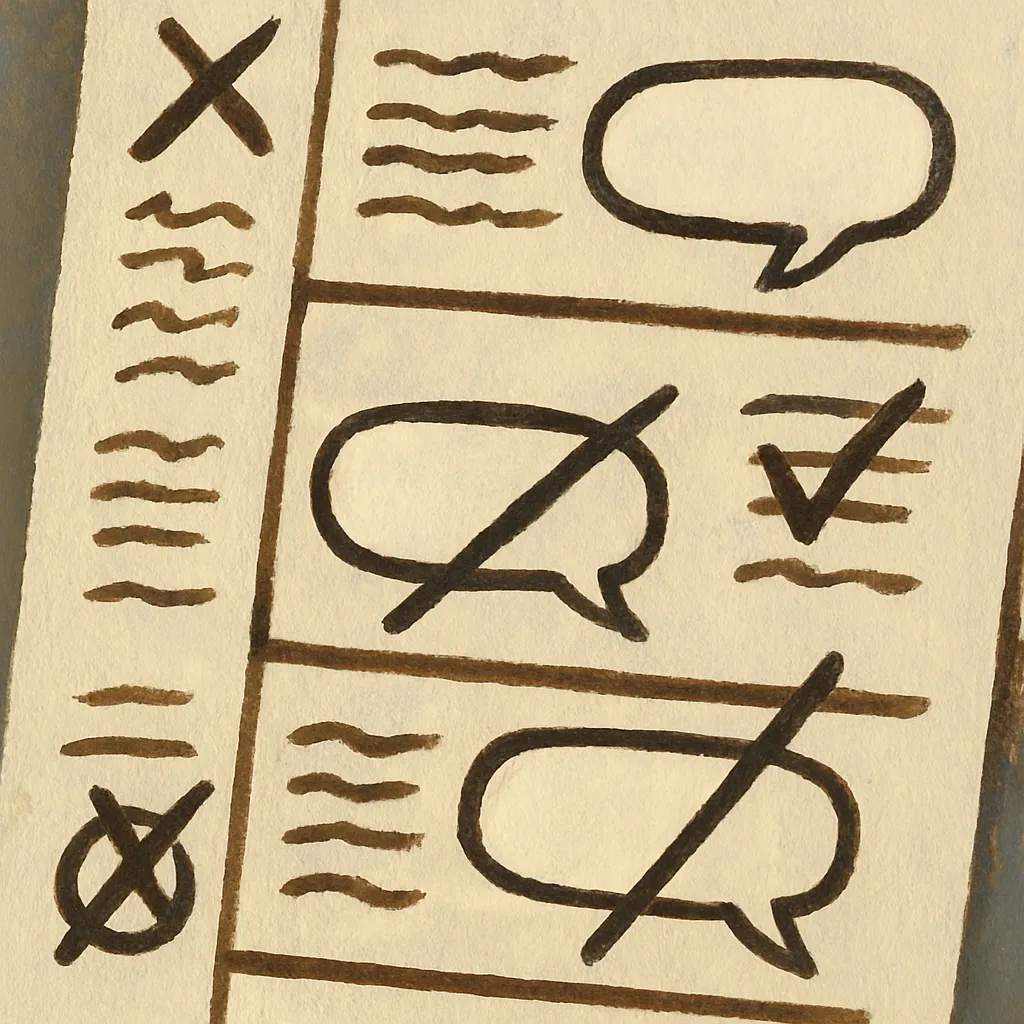
No AI output for dialogue should be treated as final until it has been read aloud, character by character, with deliberate attention to rhythm. This is true for prose, but it is especially true for comics, where the balloon shape and size will be designed to match the line. If a line trips when spoken, it will trip when read. Record yourself reading it if that helps — anything that makes you stumble is a flag for revision.
Common issues to listen for: - Two characters whose lines sound interchangeable in spoken rhythm - Lines that require the visual context to make sense (if it cannot stand alone as speech, the image is doing too much work) - Exposition dressed as dialogue (“As you know, Mara, we have been underground for six months”)
Frequently Asked Questions
How many characters can I define voice sheets for before the AI loses track of them? In practice, four to six characters is the reliable limit in a single prompt context. For ensemble casts, group your characters and run scenes with only the relevant participants present, feeding only their voice sheets into that session.
Should I write panel descriptions before or after generating dialogue? Write rough panel descriptions first. They give the AI visual context that shapes how dialogue sits in space. You will likely revise both the descriptions and the dialogue together after the first pass anyway, but starting with structure prevents dialogue that ignores the action happening in the panel.
Can AI handle dialect or non-standard English without slipping into caricature? Yes, but you need to be explicit and careful. Specify the features of the dialect in linguistic terms (dropped auxiliaries, specific vocabulary, sentence inversion patterns) rather than phonetic spelling. Phonetic spelling in comics dialogue is generally a design choice best left to lettering, not scripting.
What format does Artistik output the graphic novel script in? When you start a graphic novel on Artistik, the finished project is delivered as an illustrated ZIP file containing both the visual panels and a readable script layer, so your dialogue work is preserved alongside the artwork.
Start Building Your Graphic Novel Today
Distinct character voice is not a finishing touch — it is what makes readers care enough to turn the page. With deliberate prompting, structured voice sheets, and the three-pass drafting method, AI can be a genuinely powerful collaborator for this work rather than a source of generic filler. Head over to Artistik, build your character voice sheets, and let the panels follow from there.